


Six years ago, I asked a simple but uncomfortable question: Is the cement cartel back in action?
It was August 2020. Pakistan was emerging from the first wave of Covid-19, the government had placed construction at the centre of its economic revival strategy, and cement prices were climbing just as the state was preparing to pump billions of rupees into housing and infrastructure.
At the time, a 50kg bag of cement in the northern region averaged around Rs529, compared with Rs614 in the south. In the months immediately before publication, prices in Rawalpindi and Islamabad had jumped by roughly Rs40 to Rs45 a bag. The Competition Commission of Pakistan (CCP) was already examining whether manufacturers had coordinated their behaviour.
Six years later, the numbers are dramatically different.
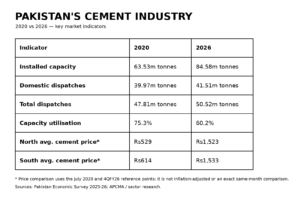
Cement capacity has expanded from 63.53 million tonnes in FY2020 to 84.58 million tonnes in FY2026. Domestic dispatches, which stood at 39.97 million tonnes in FY2020, reached 41.51 million tonnes in FY2026. Total industry dispatches rose from 47.81 million tonnes in FY2020 to 50.52 million tonnes in FY2026. Yet capacity utilisation, after falling sharply during the economic slowdown, was only about 60% in FY2026.
And prices have risen much faster than volumes.
By the fourth quarter of FY2026, average cement prices had reached Rs1,523 per 50kg bag in the North and Rs1,533 in the South, according to sector research compiled by Topline Pakistan Research. The northern average was 7.8% higher than the preceding quarter, while the southern average was 6.3% higher.
In nominal terms, that means the northern average price is almost three times the Rs529 recorded in July 2020.
But there is an important difference between 2020 and 2026.
In 2020, the central question was whether simultaneous price increases were being coordinated through an industry association that had previously been found to have used quotas and supply restrictions.
In 2026, there is no publicly established finding that the current price increases constitute a new cartel.
Instead, the evidence points to something more complicated: a much larger industry, a more concentrated ownership structure, a recovering domestic market, significantly higher prices, and a competition regulator that has once again identified structural weaknesses in the way the cement market works.
That may be a more important story than simply asking whether the old cartel has returned.
The industry has doubled its capacity — but not its demand
The biggest change since the 2020 story is the sheer amount of cement capacity Pakistan has added.
According to the Pakistan Economic Survey 2025-26, national cement production capacity increased from 45.62 million tonnes in FY2016 to 84.58 million tonnes in FY2026. Capacity utilisation improved to 60.2% in FY2026 from 55.1% a year earlier.
The trajectory explains much of what happened after my 2020 investigation.
In FY2020, capacity was 63.53 million tonnes and utilisation stood at 75.26%.
Then came the Covid-era construction boom. Domestic dispatches jumped to 48.12 million tonnes in FY2021 and total dispatches reached 57.43 million tonnes, pushing utilisation above 83%.
But the boom was followed by expansion.
Capacity reached 69.29 million tonnes in FY2022, 72.24 million tonnes in FY2023 and more than 83 million tonnes by FY2024. At the same time, domestic demand weakened dramatically. FY2023 total dispatches fell to 44.58 million tonnes and utilisation dropped to about 62%. By FY2024, utilisation was around 54%.
The industry therefore found itself with an enormous amount of installed capacity competing for a relatively stagnant domestic market.
That should, in theory, have created intense price competition.
And for much of the period, it created exactly that pressure.
But the price response was not always what a textbook competitive market would suggest.
By late 2022, for example, the average 50kg cement bag had climbed to around Rs1,043 from Rs738 a year earlier, even as construction demand was weakening. Industry representatives attributed the increase largely to coal, electricity, diesel and other input costs.
This distinction matters.
A price increase by itself is not evidence of collusion.
The cost of producing cement genuinely increased during the period, particularly after the global commodity shock and the sharp depreciation of the rupee.
The question is whether the industry subsequently acquired enough pricing power to pass through — or exceed — those costs even when capacity remained substantially under-utilised.
The cartel case that refuses to die
The most extraordinary part of Pakistan’s cement story is that the industry’s biggest cartel case is now more than 17 years old.
In 2008, the CCP raided the offices of the All Pakistan Cement Manufacturers Association (APCMA) and recovered an agreement dated May 8, 2003.
The agreement contained provisions relating to quotas and supply intended to achieve targeted prices.
In August 2009, the CCP imposed penalties equivalent to 7.5% of turnover on 20 cement manufacturers, with the combined penalty amounting to roughly Rs6.35 billion. The CCP’s own order describes the conduct as involving price fixing and fixing production quantities.
Lucky Cement’s penalty alone was approximately Rs1.272 billion; D.G. Khan Cement was fined about Rs933 million, while Maple Leaf, Bestway, Pioneer, Attock, Fauji, Cherat, Kohat and other manufacturers were also penalised.
Yet the case did not end with the penalty.
Manufacturers challenged the proceedings in court. The litigation passed through different judicial forums, and the Competition Appellate Tribunal remained dysfunctional for years.
The result is extraordinary: a competition case arising from conduct dating back to the early 2000s was still being litigated well into the 2020s.
The CCP reported that the cement cartel matter remained among the major long-running competition cases, while the Competition Appellate Tribunal began functioning again after appointments were made in 2025.
For consumers, this matters for a simple reason.
A competition penalty only acts as a deterrent if there is a realistic prospect that it will ultimately be enforced.
A fine that remains trapped in litigation for years has a very different deterrent effect from a penalty that is swiftly recovered.
Then came a new warning from the CCP
The most significant development since my 2020 investigation is that the CCP has itself returned to the structure of the cement market.
In April 2026, it released a Competition Assessment Study of Pakistan’s cement sector.
The study does not conclude that today’s cement manufacturers are operating a cartel.
Instead, it identifies structural characteristics that can make competition difficult.
The CCP says the industry comprises 16 companies operating 27 plants with combined capacity exceeding 83 million tonnes. The four largest players account for more than 56% of market share.
At the national level, the study calculates a Herfindahl-Hirschman Index, or HHI, of 1,051. But the picture changes when the market is divided geographically.
The North has an HHI of 1,222, while the South has an HHI of 2,357 — indicating substantially greater concentration in the southern market.
That distinction is critical.
Pakistan does not really have one homogeneous cement market.
Transport costs are high. Cement has a low value-to-weight ratio. Plants are located close to limestone deposits, while consumption is concentrated elsewhere. Moving cement over long distances can quickly erode the economics of competing with a producer located closer to the customer.
This creates regional markets in which a handful of manufacturers can become disproportionately important.
The CCP explicitly recognises this.
Its study says competition is affected by high capital requirements, transportation costs, seasonal demand, provincial differences in limestone royalties, energy costs, taxation and the structure of coal handling infrastructure.
In other words, the regulator’s 2026 diagnosis is broader than the cartel question.
Consolidation is changing the players
There is another development that would have been almost impossible to ignore in the 2020 story: consolidation.
When I wrote that story, the industry had already shrunk from 22 manufacturers to roughly 15 major APCMA members through expansion, mergers and acquisitions.
Six years later, consolidation has accelerated.
Fauji Cement and Kot Addu Power Company received CCP approval in February 2026 to acquire control of Attock Cement.
Meanwhile, Maple Leaf Cement moved further into Pioneer Cement.
The CCP had already approved Maple Leaf’s acquisition of additional Pioneer shares in December 2025, concluding that the transaction would not create or strengthen a dominant position in the national cement market.
By February 2026, Maple Leaf’s holding in Pioneer had increased substantially, and in September the Maple Leaf board approved a scheme to merge Pioneer Cement into Maple Leaf, subject to shareholder, court and other regulatory approvals.
This is precisely the kind of consolidation that deserves attention when discussing competition.
In the 2020 article, I had argued that further mergers and acquisitions could make cartelisation easier by reducing the number of independent players.
The industry has since moved further in that direction.
But consolidation itself is not illegal and does not automatically mean collusion.
The relevant question is whether fewer, larger producers have sufficient market power to influence prices or output without effective competitive pressure.
That is a question for competition law and empirical market analysis — not an assumption.
The big four are getting bigger
The concentration figures are striking.
A 2026 industry analysis puts Bestway and Lucky at roughly 17.7% and 16.3% market shares respectively, with Fauji Cement at approximately 13.2%. Together, the three account for close to half of industry sales.
PACRA’s latest sector analysis shows Lucky Cement with approximately 9.67 million tonnes of FY2026 dispatches, followed by Bestway at about 7.04 million tonnes, Fauji at 5.72 million tonnes and D.G. Khan Cement at 5.49 million tonnes.
The result is a very different industry from the one I described in 2020.
Then, the debate was about whether manufacturers could maintain a common quota and pricing mechanism despite having incentives to cheat.
Today, several of the largest companies possess enormous production bases, national or multi-regional distribution networks and stronger balance sheets.
That can produce efficiencies.
It can also produce greater market power.
Both possibilities need to be considered.
And now demand is finally coming back
This is perhaps the most important reason why the cartel question has resurfaced.
After years of weak construction activity, cement demand finally recovered in FY2026.
APCMA data shows domestic cement dispatches rose 9.5% to 41.51 million tonnes from 37.91 million tonnes in FY2025.
Total dispatches increased 7.21% to 50.52 million tonnes.
Exports, however, declined 2.19% to 9.01 million tonnes.
The first two months of FY2027 have broadly continued the recovery.
July dispatches increased 6.02% year-on-year to 4.476 million tonnes, with domestic sales rising 17.28% to 3.771 million tonnes.
August was weaker: total dispatches declined 0.7% year-on-year to 4.039 million tonnes, while domestic dispatches fell 1.07%. Yet July-August combined dispatches still increased about 2.8%, with domestic dispatches up 8.04%.
So the recovery is real, but uneven.
And that is precisely the environment in which pricing behaviour deserves scrutiny.
When demand is weak and plants are running at 50-60% utilisation, producers have an incentive to fight for volume.
When demand starts recovering while capacity remains constrained by regional logistics and ownership becomes increasingly concentrated, the balance can change.
The money tells another story
There is another number that deserves attention.
Pakistan’s listed cement companies collectively crossed Rs100 billion in annual profit during FY2026.
According to AKD Securities, the covered listed companies earned Rs108.5 billion in FY2026, up 18% from Rs91.73 billion in FY2025.
Their combined sales rose 7% to Rs494.2 billion, while gross profit increased 7% to Rs169.1 billion.
The sector’s gross margin remained around 34.2%.
Another sector compilation by Topline Research puts the full listed sector’s FY2026 profit at approximately Rs143 billion, with net sales of Rs715.4 billion. The difference between the two figures reflects differences in the companies covered and methodology, but both datasets point in the same direction: cement profitability recovered sharply during FY2026.
This is not, by itself, evidence of profiteering or cartelisation.
Lower interest rates helped.
Domestic volumes recovered.
Finance costs fell.
Companies benefited from better capacity utilisation.
Some producers had accumulated lower-cost fuel inventories.
And prices did rise.
For example, D.G. Khan Cement reported FY2026 revenue of Rs79.6 billion and profit after tax of Rs11.4 billion, with retention prices rising 8% year-on-year to Rs14,602 per tonne.
So there are legitimate commercial explanations for stronger earnings.
But strong earnings combined with rising prices and a more concentrated industry are precisely the conditions under which competition authorities need reliable, timely data.
The price puzzle
The most interesting number may be the price itself.
In the fourth quarter of FY2026, average bag prices were Rs1,523 in the North and Rs1,533 in the South.
In July 2020, the corresponding averages were approximately Rs529 and Rs614.
The northern price therefore increased by roughly 188% between those reference points, while the southern price increased by roughly 150%.
These are nominal comparisons; they do not adjust for inflation, taxation, energy, transport, exchange-rate movements or changes in industry costs.
Nevertheless, the magnitude of the increase is impossible to ignore.
And the CCP’s own study provides part of the explanation.
The Commission says fuel and power represent the largest component of cement manufacturing costs and that taxes and duties — particularly Federal Excise Duty and sales tax — can account for a very substantial share of the final price. It also identifies international coal prices, freight and construction demand as major determinants of cement prices.
So the simplistic argument that “cement companies raised prices, therefore there is a cartel” does not survive scrutiny.
But neither does the opposite argument that every increase must therefore be explained entirely by costs.
The market needs transparent evidence.
What happened to the warning in my 2020 story?
In 2020, I argued that the cartel risk would become more serious once construction demand recovered.
The subsequent history is more complicated than that prediction.
The industry did not immediately return to the old quota model.
Instead, capacity expanded dramatically.
Demand collapsed.
Utilisation fell.
Costs surged.
Prices nevertheless increased substantially.
Manufacturers largely protected margins rather than engaging in the kind of destructive price war that analysts had anticipated during the expansion cycle.
Then, in FY2026, demand began recovering and capacity utilisation improved.
At the same time, consolidation accelerated.
That combination — recovering demand + concentrated ownership + higher prices + significant unused capacity — deserves much closer scrutiny.
But the proper question in 2026 is no longer simply:
“Is the cement cartel back?”
It is:
“Has Pakistan created a cement market in which a small number of increasingly large producers can maintain pricing discipline without necessarily needing the kind of explicit cartel agreement that investigators found in the past?”
That is a much harder question to answer.
And it requires much better data than Pakistan has traditionally made public.
What regulators should be watching
The first priority should be pricing and cost transparency.
If manufacturers increase prices simultaneously, the CCP should be able to compare factory-gate prices, retention prices, dispatches, capacity utilisation, coal costs, electricity costs, freight and dealer margins company by company.
Second, the regulator needs to monitor information exchange through industry associations.
The 2003 agreement recovered from APCMA’s premises is a historical warning about how an industry association can become relevant to competition enforcement. The existence of an industry association is not itself suspicious; the issue is whether commercially sensitive information is being exchanged or coordinated in ways that restrict competition.
Third, merger control becomes increasingly important.
The acquisition of Attock by Fauji Cement/Kot Addu Power and the continuing integration of Pioneer into Maple Leaf demonstrate how rapidly the competitive landscape is changing.
Fourth, regional competition needs to be examined separately.
The CCP’s own HHI figures show why a national average can conceal concentration at the regional level. A market that appears competitive nationally can still have pockets where only a few companies have meaningful competitive presence.
Finally, Pakistan needs to make imports a credible competitive discipline.
If domestic producers know that imported cement cannot easily enter the market because of taxes, freight, border restrictions or regulatory barriers, the threat of foreign competition becomes weaker.
The CCP itself has called for stronger border enforcement against untaxed and uncertified cement, but also for reforms to reduce structural barriers, harmonise limestone royalties, improve logistics and introduce greater competition in coal handling.
The cartel may not need to look like a cartel
This is where the story has become more interesting than it was in 2020.
The old model was relatively simple: quotas, coordinated supply and price fixing.
The modern risk is potentially subtler.
An industry does not necessarily require a written agreement setting prices if market structure itself allows producers to anticipate one another’s behaviour and maintain pricing discipline.
That does not mean that “conscious parallelism” is proof of a cartel. It is not.
It means that competition authorities must distinguish between legitimate parallel commercial behaviour and unlawful coordination using evidence such as communications, information exchanges, output restrictions, market allocation, coordinated pricing mechanisms or other conduct prohibited under competition law.
Pakistan has already learned the cost of leaving these questions unresolved for decades.
The original cement cartel penalty was imposed in 2009.
Seventeen years later, the underlying legal dispute has still cast a long shadow over competition enforcement.
Meanwhile, the industry has grown from 63.5 million tonnes of installed capacity in FY2020 to 84.6 million tonnes today.
The country is consuming more cement again.
Prices are substantially higher.
Profits have recovered.
And ownership is becoming more concentrated.
That does not prove the cartel is back.
But it does mean that the question deserves to be asked again — with better data, stronger enforcement and considerably less patience for another seventeen-year legal saga.