

Arithmetic is possible. The existing economic machinery makes it difficult. Pakistan’s real test is whether it can transform productivity, exports, human capital and governance before 2035.
A trillion dollars is an attractive number. It is also a useful discipline. Pakistan’s government has set the ambition of building a US$1 trillion economy by 2035. Planning Minister Ahsan Iqbal has framed the choice starkly: under business as usual, Pakistan could be around US$600 billion; with transformational governance, it could reach US$1 trillion. More recently, the government has linked the target with sustained growth of around 6 percent and exports exceeding US$100 billion. Importantly, it acknowledges that continuation of the status quo will not deliver the desired outcome.
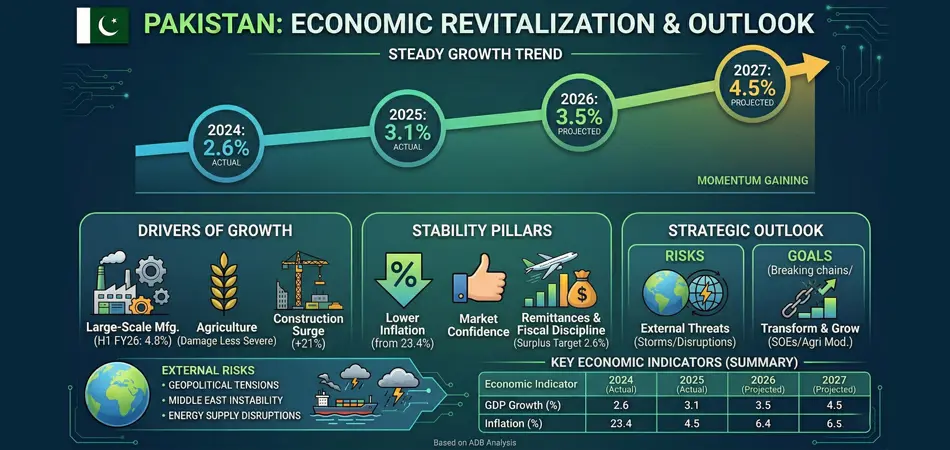
The target deserves neither applause nor ridicule. It deserves arithmetic. According to the World Bank, Pakistan’s gross domestic product (GDP) was about US$407 billion in 2025, with GDP per capita of only about US$1,596. Moving from US$407 billion to US$1 trillion over ten years requires nominal GDP measured in US dollars to grow at roughly 9.4 percent every year.
That is possible mathematically. Economically, it is demanding. Six percent real growth alone will not produce the result. Pakistan must also avoid persistent currency depreciation wiping out domestic growth when measured in dollars. Investment must rise. Productivity must improve. Exports must grow much faster than in the past. Above all, population growth means that aggregate GDP expansion cannot be confused with improvement in individual prosperity.
The real question is not whether Pakistan can become a trillion-dollar economy. It is: what kind of Pakistan would a trillion-dollar economy have to be?
Growth without transformation
Pakistan has experienced episodes of respectable growth before. They repeatedly ended in external-account stress. The mechanism is familiar. Consumption and imports accelerate. Exports fail to keep pace. Foreign exchange becomes scarce. Reserves fall. Borrowing increases. Stabilisation follows. Investment and development spending are compressed. Growth slows. Once stability returns, another consumption-led cycle begins.
The World Bank describes the underlying problem in unusually plain language. Pakistan’s growth model combines structural fiscal deficits with low private investment and productivity. Persistent deficits produce debt and government borrowing, which crowd out private credit. Debt servicing then crowds out public investment. Trade distortions and a large state footprint weaken productivity and export competitiveness. Consumption-led growth eventually generates another external imbalance.
This is not principally a shortage of economic plans. Pakistan has produced plans in abundance. It is a failure to transform the relations between the state, production and finance. A government that consumes a large share of domestic financial savings cannot simultaneously complain that private investment is inadequate.
The State Bank of Pakistan has described the resulting “sovereign-bank nexus”: government borrowing has increasingly absorbed banking-sector resources that might otherwise finance productive enterprise. One SBP study reported banking-sector exposure to government at more than 60 percent of banking assets.
Banks are responding rationally to incentives. Why undertake the expensive work of evaluating a new manufacturer, farmer or exporter when the sovereign offers large volumes of comparatively attractive paper?
A trillion-dollar economy cannot be built principally by lending national savings back to the government.
The export test
The government is correct to place exports at the centre of its 2035 ambition. In September 2026, the Planning Ministry said Pakistan could not sustain 6 percent growth, reach US$1 trillion or meet external financing obligations without an export-led transformation. It set an objective of exceeding US$100 billion in exports by 2035 and acknowledged that Pakistan had relied for too long on external borrowing and multilateral financing to meet foreign-exchange requirements.
That diagnosis is important. Exports do more than earn dollars. Successful exporting forces firms to compete on quality, productivity, technology, delivery, branding and price. An economy protected indefinitely from competition can redistribute domestic purchasing power among favoured groups. It cannot command purchasing power from the rest of the world.
Pakistan consequently needs to move beyond the old argument about providing incentives to existing exporters. The objective should be to create new export capabilities.
Agriculture must move from low-value output towards processing, storage, certification and global food chains. Textiles must climb from basic products into design, technical textiles and brands. Information technology must become an ecosystem rather than a source of freelance earnings alone. Engineering, pharmaceuticals, minerals and services require regulatory systems capable of meeting international standards.
Districts and cities matter here more than federal slogans. Export capability is created in places where firms, workers, universities, logistics, finance and municipal services interact. That requires a functioning local government.
The missing productive state
Pakistan’s administrative structure remains strikingly disconnected from its economic ambitions. A modern economy requires specialist institutions. Energy must be managed by energy professionals; taxation by trained tax administrators and economists; cities by elected metropolitan governments and professional planners; trade by people who understand production chains and international markets; technology by those capable of understanding technology.
Pakistan instead retains an administrative culture in which generalist bureaucratic control frequently substitutes for specialist institutional capacity.
Digitising that structure will not by itself modernise it. An inefficient approval process placed online remains an inefficient approval process. Artificial intelligence attached to a badly designed institution does not correct its incentives. Technology becomes transformative only after the government decides what should be centralised, what should be devolved, what should disappear and who should be accountable for results.
The same applies to fiscal federalism. Pakistan cannot realistically aspire to trillion-dollar output while its largest urban economies lack the autonomy, revenues and integrated authority normally associated with globally competitive metropolitan governments. Economic production takes place locally even when economic policy is announced federally.
The human-capital constraint
The greatest obstacle may be neither debt nor dollars. It is people. The World Bank’s latest assessment presents a disturbing picture: nearly 40 percent of Pakistani children are stunted; about one-quarter of primary-school-age children are out of school; and around three-quarters of children attending primary school cannot read and understand a simple story by the end of the primary cycle. More than 85 percent of employment remains informal. These are not merely social-sector statistics. They are macroeconomic constraints.
A child suffering malnutrition today enters the 2035 labour force with consequences that cannot be reversed by an export subsidy. A child who spends years in school without learning cannot suddenly become a productive technician because the government announces an industrial cluster.
Physical and human infrastructure are not competing claims on scarce development resources. They complement one another. A motorway without skilled producers can facilitate imports. Broadband without education can enlarge consumption. Electricity without competitive firms can deepen circular debt. Infrastructure becomes productive when people and institutions can use it.
Borrowing must leave something behind
This also requires a different philosophy of public debt. China and India used substantial long-term multilateral financing while building infrastructure and productive capability. Pakistan has also borrowed for productive assets—major energy and infrastructure projects provide clear examples. The problem is the repeated need to borrow for budgetary support, external financing gaps and recurring reform programmes.
The relevant test for every new sovereign loan should be uncomplicated: What will Pakistan possess when this debt has been repaid?
For a dam, the answer can be electricity and reduced fuel imports. For transport infrastructure, it can lower logistics costs. For education, measurable learning. For health, healthier and more productive citizens.
The test should be equally rigorous for loans labelled “reform”. If hundreds of millions of borrowed dollars are spent reforming taxation, justice, public administration or state-owned enterprises, the asset left behind must be demonstrably stronger institutions. Otherwise, Pakistan inherits the liability while the next government borrows again to reform the same institution.
The World Bank itself appears to recognise this problem. Its new ten-year Country Partnership Framework says it intends to move away from short-term adjustment programmes and scattered small investments towards more selective, stable and larger investments capable of producing sustained development. Pakistan should demand no less of itself.
From US$1 trillion to Pakistan@100
There is another reason not to make 2035 the final horizon. Pakistan turns 100 in 2047. A trillion-dollar economy by 2035 would be an intermediate milestone, not a national destination. The meaningful question for Pakistan@100 is what kind of society will inhabit the economy represented by that number.
A country can have a large GDP and remain profoundly unequal, poorly educated and badly governed. Aggregate size cannot substitute for human development.
The ambition for 2047 should be broader: high productivity; universal quality education and healthcare; globally competitive exports; reliable energy; modern agriculture; empowered cities and local governments; affordable finance for productive enterprise; broad, low-rate and predictable taxation; independent justice; and a state capable of living substantially within the revenues generated by a prosperous society.
Pakistan possesses strategic capability of the highest order. The unresolved challenge is to translate national capability into human and economic capability.
The government’s trillion-dollar target is useful precisely because it exposes the distance between ambition and institutional reality. The arithmetic says US$1 trillion is conceivable. Political economy says something more demanding: Pakistan cannot reach a fundamentally different economic destination while preserving substantially the same machinery that produced the present one. The transformation required is therefore larger than GDP. It is the transformation of the state itself.